Stop bad data at ingest, between stages, and on the way out — before your warehouse, reverse ETL, partners, or AI agents.
Docker with Compose, and make. No Supabase account, no API key, and no sign-up. The dashboard opens at http://localhost:3000 with starter contracts and a live event stream.
The same contract engine can sit at ingest, between stages, and on egress. Bad payloads get rejected or quarantined before they cross that boundary. Keep the dbt, Great Expectations, and Soda tests you already run after modeling — those check your logic; DataContractGate checks the data at the edges. See the interactive pipeline map →
Upload sample payloads — the contract writes itself. DataContractGate ingests your real event samples and infers field types, value ranges, enums, cardinality, freshness constraints, and PII markers automatically. Review, tweak, and promote. Teams who want full control can also author YAML directly and version it alongside their code.
Point your producers at the DataContractGate ingest endpoint. Every event is validated against the promoted contract version before touching storage.
Passing events flow downstream. Failures stay in quarantine with the failure and the reason. Replay and bulk replay are included on Self-Hosted Free, Pro, and Enterprise.
Bad data is a $12.9B/year problem for US enterprises alone. DataContractGate stops it at the source.
Bad training data poisons models silently. DataContractGate ensures every event feeding your feature store meets the semantic contract your ML team defined — before it corrupts a training run.
A single malformed transaction amount can cascade through an entire ledger. Enforce amount ranges, currency codes, and account ID patterns at ingestion — with full audit trail for compliance.
HIPAA-covered fields need to be identified, masked, or hashed before reaching storage. DataContractGate's PII transform rules enforce this automatically on every inbound record.
Clickstream events silently drop required fields when clients update. Catch the regression in real time — not three days later when the A/B test results make no sense.
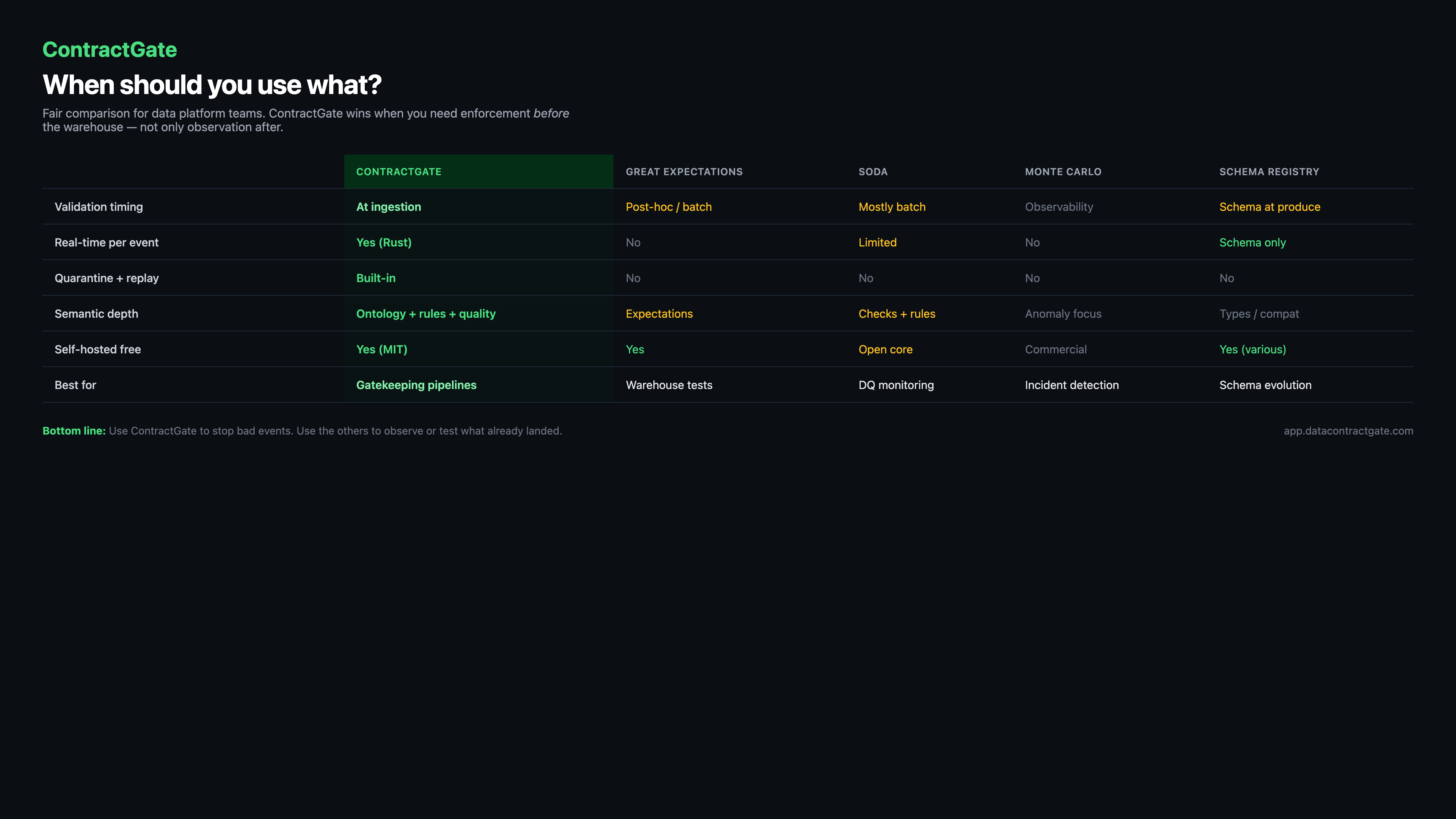
Post-modeling tests (dbt, Great Expectations, Soda) check your logic after processing. DataContractGate verifies payloads as they cross boundaries — so the gate has to be fast enough not to matter on the hot path.
The validation engine is written in pure Rust. Regexes compile once at contract load time. No GC pauses. No JVM warmup. Passing p99 is 0.93 µs, and throughput is 1,547,368 events/sec, in-process on one thread on the recorded host. Bench README.
Unlike JSON Schema or Avro, DataContractGate validates meaning — not just shape. An amount field with a negative value is wrong even if the type is correct.
Declare PII fields in the contract YAML. DataContractGate automatically hashes, masks, or drops them before storage — per-contract, with format-preserving options for analytics.
Call POST /v1/ingest or POST /egress/{contract_id} directly or through the Python and TypeScript SDKs. Contracts, versions, quarantine and replay are managed in the dashboard. Kafka and Kinesis streaming ingress is available on request on Enterprise plans.
Failed events stay in quarantine with the failure and the reason. Replay and bulk replay are included on Self-Hosted Free, Pro, and Enterprise.
Contracts go through draft → stable → deprecated lifecycle. Producers can pin to a specific version or always track stable — with full version history and promotion audit.
AISchemaGate validates the JSON an LLM or AI agent returns against a semantic contract before your code acts on it. It runs on the DataContractGate backend and uses the same account, API keys and dashboard.
Infer a contract from 5–20 known-good JSON outputs, then tighten enums, ranges, patterns and required fields.
The Python and TypeScript SDKs pull the JSON out of OpenAI, Anthropic, vLLM or Ollama responses and validate it. A pass returns the sanitized payload; a failure returns the violations.
With auto-repair on, the model gets the violations back as a re-prompt, up to a bounded retry budget. Non-streaming responses only in v1.
Enterprise teams get dedicated deployments and custom SLAs.
Self-Hosted Free quarantine is local, with no row cap. Cloud Free keeps failure details, up to 50,000 held, for 7 days. Pro keeps record bodies, with replay and bulk replay, for 90 days. Enterprise retention is custom.
| Feature | Self-Hosted Free | Cloud Free | Pro | Enterprise |
|---|---|---|---|---|
| Quarantine | Local, no row cap | Failure details, up to 50,000 held, 7 days | Record bodies, replay and bulk replay, 90 days | Custom retention |
| Replay & bulk replay | Included | Not included | Included | Included |
Failure details, up to 50,000 held, for 7 days.
Self-Hosted Free, Pro, and Enterprise. Cloud Free does not.
We're looking for 5–8 advisory users — data engineers and platform leads who've fought bad events in production. Free access, async-only, no sales call required.
One-pagers and decks for outbound, pilots, and stakeholder share-outs. All files live under /marketing/ on this site.
The playbook is written for the agent, not for you. It finds your event shape, infers a contract from real samples, deploys it, wires your producer to the gateway, and verifies with a dry run before anything is written.
https://datacontractgate.com/llm-integration.md https://github.com/nightmoose/contractgate implement this in my repo